

By Mike Grundmann, contributor
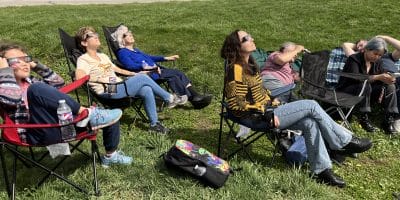
Peggy Plass held a selfie stick straight up in the air, with a sophisticated microphone on its tip. It was dusk at the JMU Arboretum, time for bats to come out of the trees and do their nighttime bug hunting.
The app on her phone, receiving what the mic picked up, emitted chirps that were audible translations of the bats’ echolocation frequencies, which are too high for the human ear. On the phone’s screen were green smudges for each chirp, and the app displayed its best guess of which species uttered them.
A small crowd, drawn by publicity for an educational bat-watching session, issued oohs and ahhs.
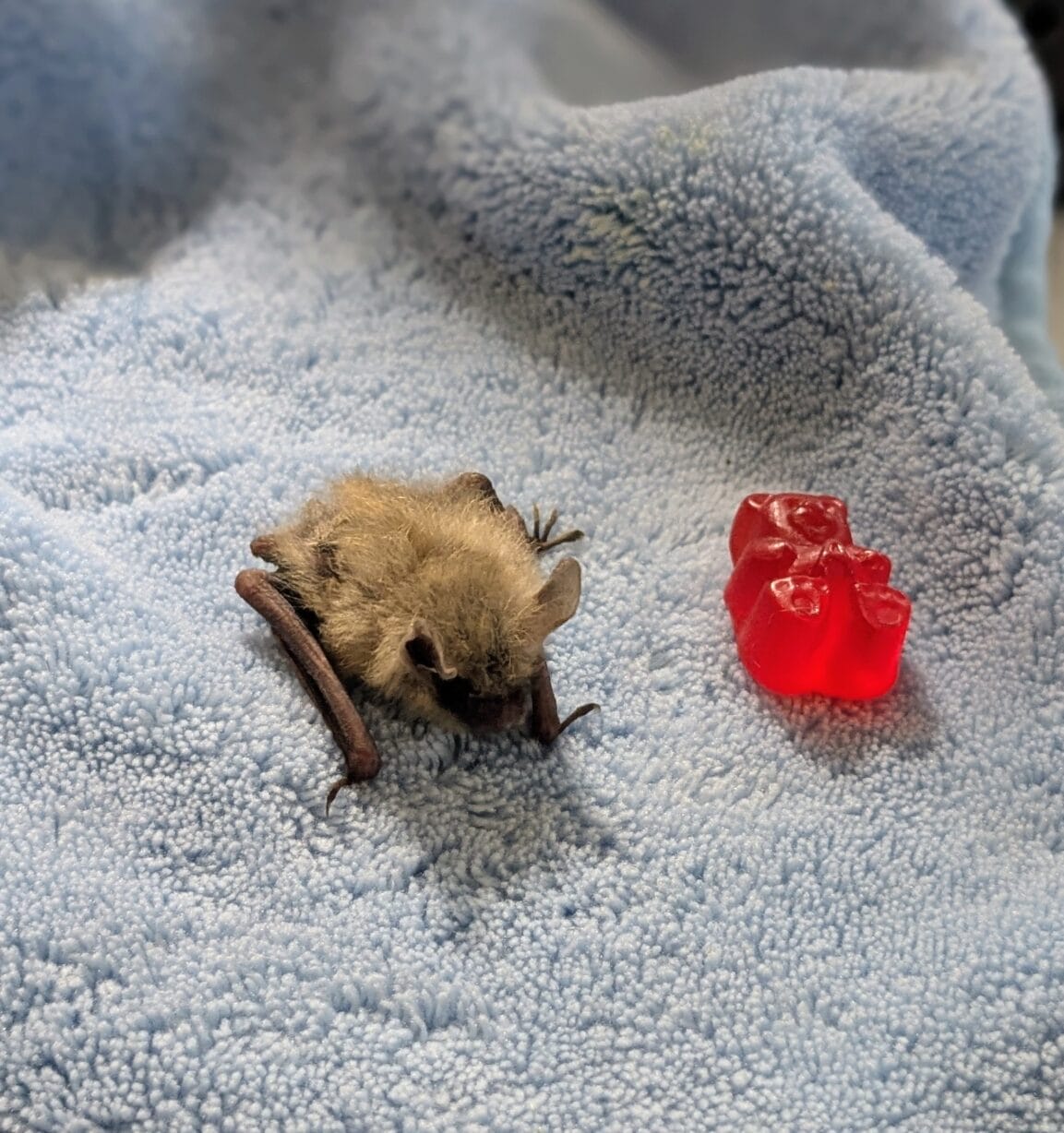
“Harrisonburg has a healthy population of bats,” said Plass, and that especially includes Westover Park. Middle and high school entryways have also recently attracted bats. The tiny, endangered tricolor species is well represented here. How tiny? As small as a gummy bear.
Sept. 19 was the last of the year’s biweekly bat education events at the Arboretum, which started in April, all under the auspices of Bat Conservation & Rescue of Virginia. At the Sept. 5 event, two bats that BCRV had rescued and rehabilitated were released, to heartfelt tears. Other BCRV events have been held at Hillandale Park in Harrisonburg and Grand Caverns Park in Grottoes.
Plass, BCRV’s board chair, a certified Master Naturalist and director of JMU’s Justice Studies department, gives superlative credit to Leslie Sturges of Mt. Solon, president of the nonprofit.
Sturges is “an amazing educator,” said Plass, “visiting schools, libraries, bringing ‘ambassador’ bats to show-and-tells.”
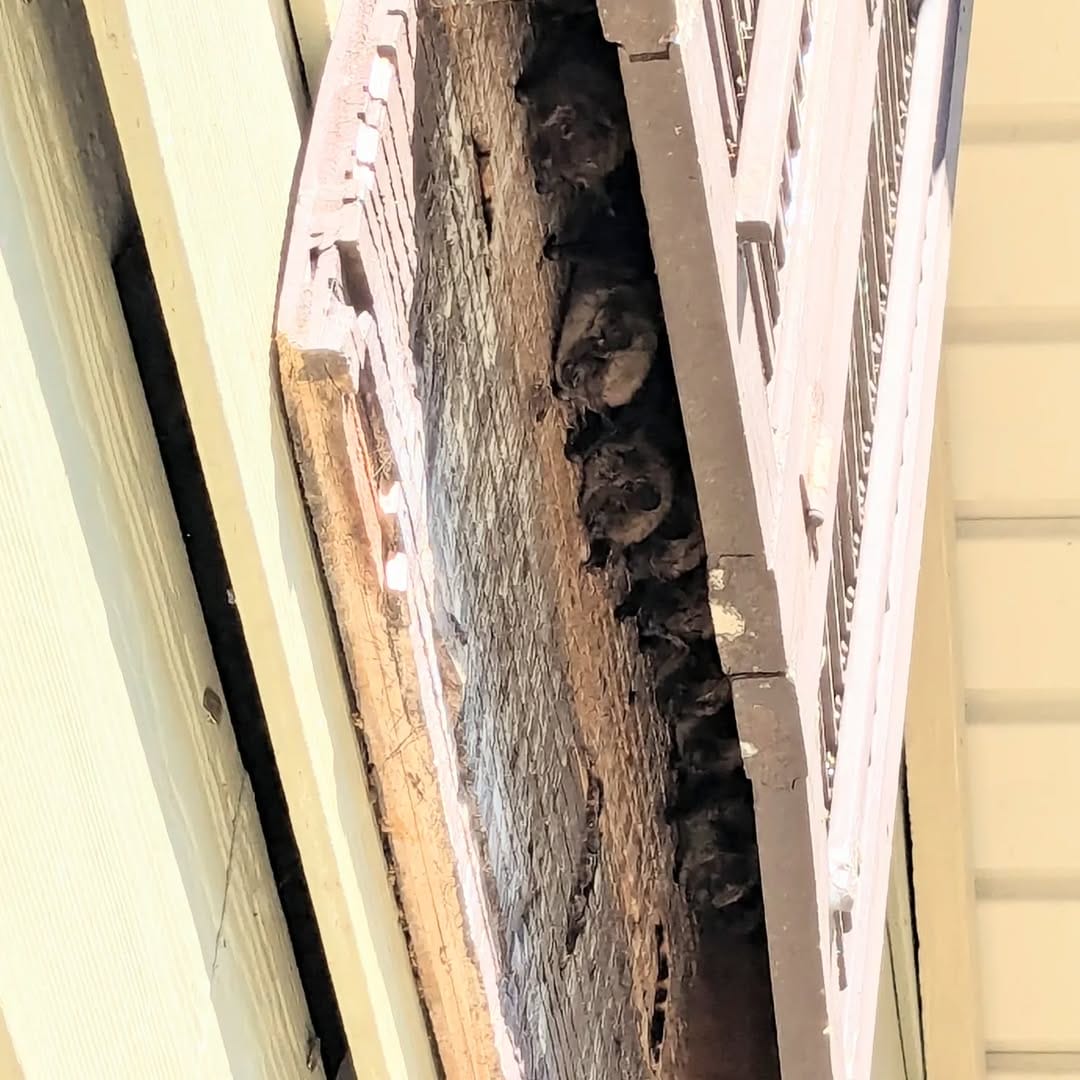
A retired park naturalist and former keeper at the National Zoo, Sturges estimates that she spends 60 to 80 hours a week on bat rescue and rehab during the summer orphan season. In winter, it’s about half that.
Anyone who spots a bat that looks distressed, stranded or trapped should text BCRV at 703-973-3157 to trigger a rescue. They shouldn’t touch the bat because of the very slight chance of rabies.
“I’ve been doing this 25 years and I’ve had fewer than a dozen cases of rabies,” Sturges said. As a bat handler, she must get the rabies vaccine.
The worst fate for many cave-dependent bat species is white nose syndrome, a fungus on the nose and wings.
“It’s driven the population so low, we’re dealing with a remnant population,” Sturges said. “We’ve lost 90% in the Northeast through the mid-Atlantic.” By the time Sturges sees them, almost all are dying or dead.
Aside from BCRV’s rescue centers in Richmond and Fairfax, Sturges’ bat-rescue territory is Rockingham and Augusta counties and the central Valley. Surrounded by two mountain ranges, the Valley has plenty of caves to serve as habitat.
So far this year, Sturges has rescued 138 bats. Virginia has 17 species, ranging from the tiny tricolor to the hoary, which has a wingspan of 16 inches. Half of Virginia’s species are rare, threatened or endangered.
Orphaned pups rescued for rehab on Sturges’ property need to be fed around the clock, sometimes every two hours. Three college interns help with feeding and other chores and soon become enchanted.
“I was asking them their favorite species,” Sturges said. They often favor the big browns “because they ‘re so silly. Like, they come charging out to greet you at feeding time. Big browns are like chocolate Labs — goofy, happy.” And many bats roost in tight clusters, like monkey bread. While a bat’s “hands” are wings with bones for elongated fingers, their feet have five articulate toes to hang by.
One intern, biology major Laine Rigel of Penn State, wrote that she was charmed by one bat that “would follow me around the spacious indoor flight cage whenever I was cleaning, eagerly searching for treats. … Eventually, he learned that he needed to embrace his bat nature and hunt for his own food.”
Orphans, besides needing the best approximation of mother’s milk, can devour mealworms (future beetles). Followers of the BCRV Facebook page saw a fund-raising plea as a big bill came due: $900 for mealworms for the Mt. Solon, Richmond and Fairfax rehab centers to last four months.
Sturges and her husband built a small BCRV “headquarters” on their property and, next to it, the octagonal, metal-mesh flight school, which features hanging pool noodles for bats to navigate and a side hatch that opens to let bats try their wings in the real world and return. The HQ, besides housing a cluttered office, holds numerous zippered enclosures for bats to roost and feed. They prefer nesting in folded fabric to maintain their “torpor,” a state of low energy, especially in daylight.
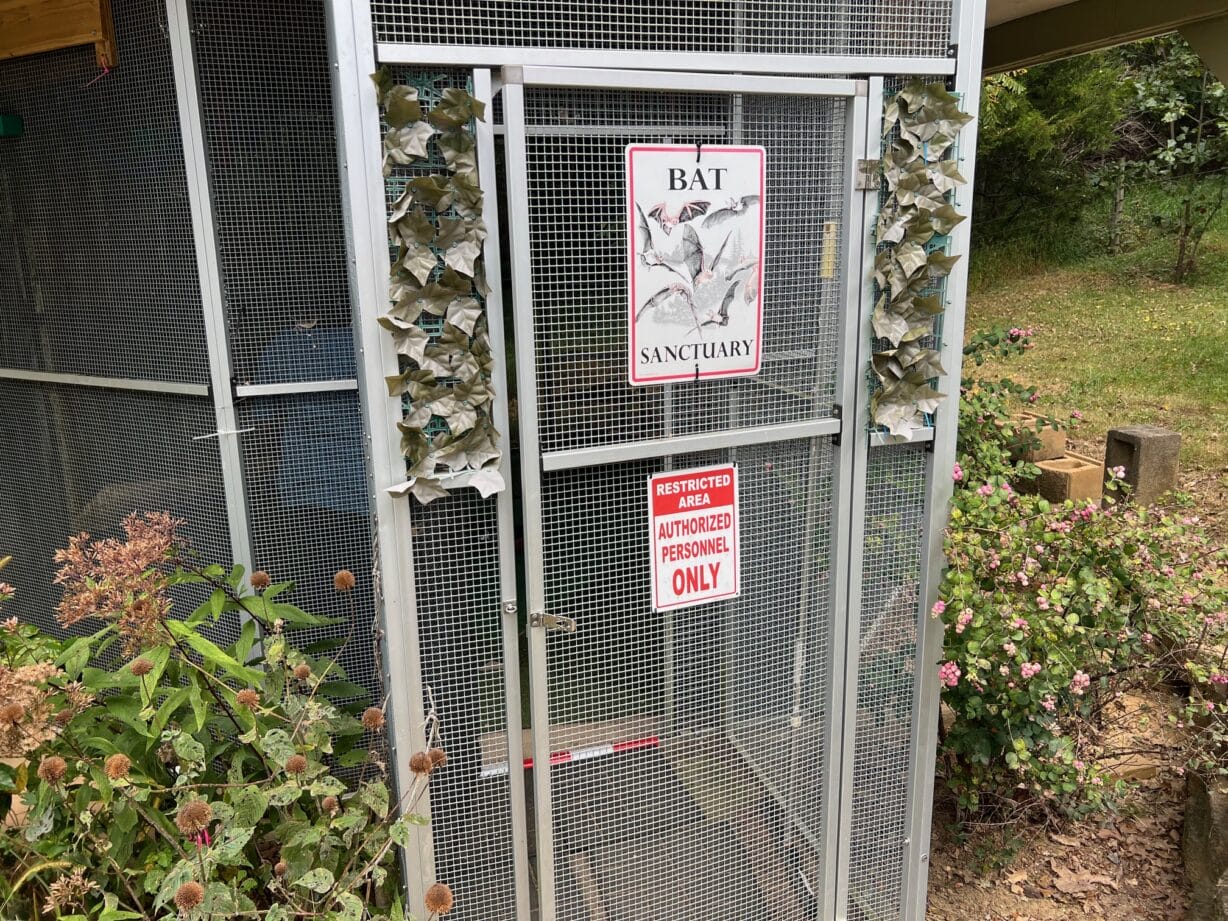
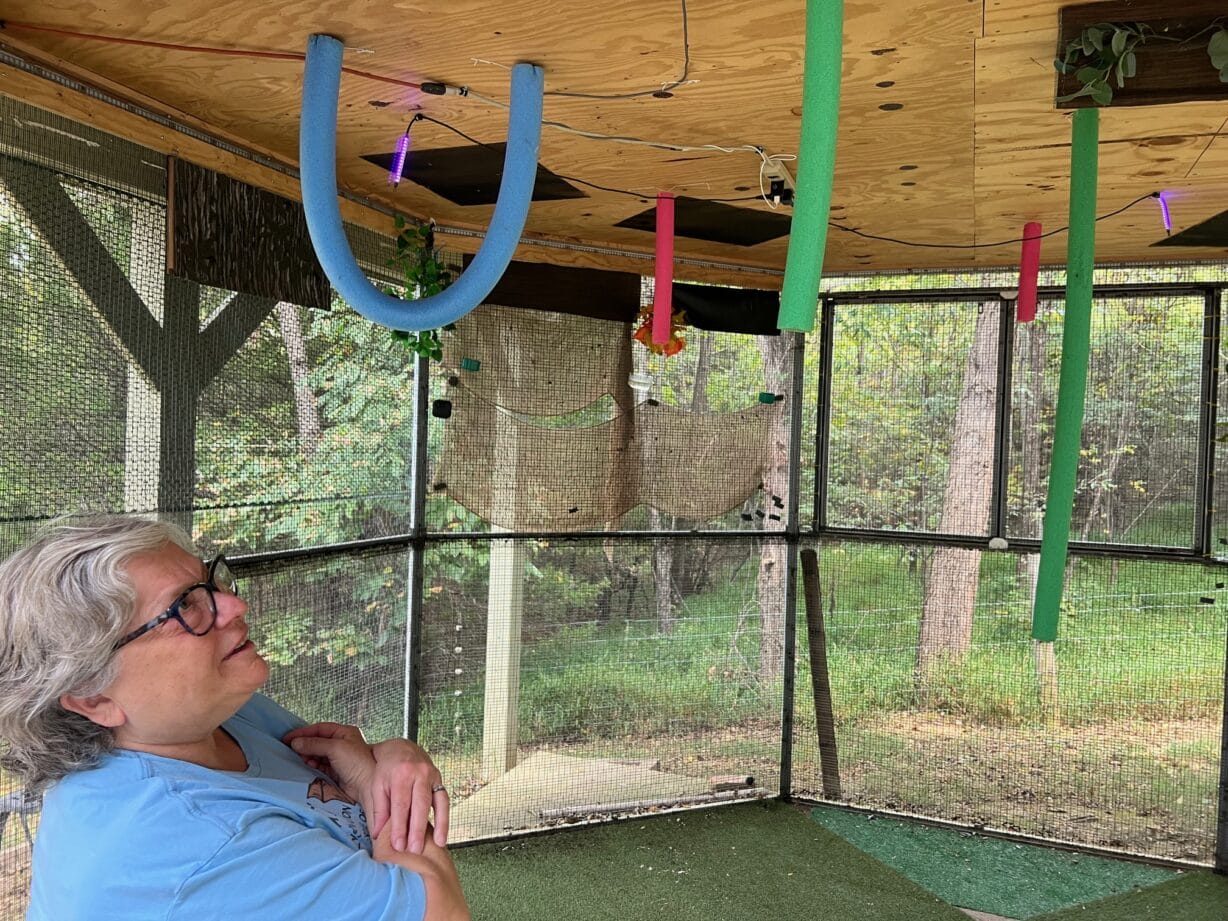
Mombat was a pregnant tricolor rescued from the breezeway of a Harrisonburg apartment complex with pinholes in her wings. She was rescued and rehabbed, passing flight school and earning release at the Arboretum Sept 5. Her son couldn’t master sustained flight at proper altitude and will be held back for release in the spring.
Some rescued bats are transferred to the Wildlife Center of Virginia in Waynesboro if they have complex wounds, need surgery or require euthanasia.
Besides falling or being trapped, hazards for bats include cars, cats, other predators and glue traps, which are increasingly used to eradicate mice or bugs. Trapping a bat that could otherwise feed on insect pests is self-defeating.
In summer, many bats must eat their own weight in food, with mating and hibernation seasons coming. Halloween is not prime time for bats, since they’re already in hibernation for winter.
Sturges and Plass both dispel certain misconceptions: that all bats have rabies (extremely rare), that they’re blind (far from it) and that they eat mostly mosquitoes. They actually eat a lot of other bugs, including the red-spotted lanternfly now plaguing the eastern half of the U.S., as well as stinkbugs.
Another controversial claim is that bats are responsible for COVID-19, because “the jury is still way out” on the scientific evidence, Sturges said.
What about vampire bats, which slurp blood? Only three of the 1,462 bat species do, and they’re in Mexico and Latin America.
Finally, what about the popular and impressive nightly flock coming in and out of the Brothers Brew Co. complex on North Main Street in Harrisonburg? Nice show, but those are chimney swifts, and that’s another story.
Mike Grundmann is a retired JMU journalism professor who previously worked as a reporter and editor for eight California newspapers, including the Los Angeles Times. He has produced 10 award-winning documentaries.
Thanks for reading The Citizen, which won the Virginia Press Association’s 2022 News Sweepstakes award as the top online news site in Virginia. We’re independent. We’re local. We pay our contributors, and the money you give goes directly to the reporting. No overhead. No printing costs. Just facts, stories and context. We value your support.