


A contributed perspectives piece by Philip Herrington
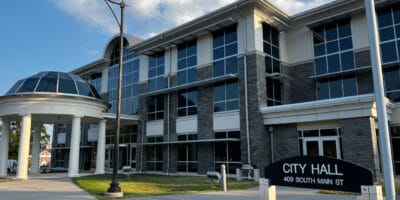
If you look carefully as you walk along South Main Street between the Lindsey Funeral Home and Harrisonburg City Hall, you’ll notice a brick-paved path to nowhere. In city tax records this is still 435 South Main Street, but the late-nineteenth-century house that once stood here came down in May 2009. Shortly after, on the same block, the houses at 455 South Main and 282 South Liberty were demolished. In 2011, 495 South Main and 294 South Liberty were also reduced to rubble.
All these houses stood in the Harrisonburg Downtown Historic District, created in 2005 and included in the National Register of Historic Places.
This Tuesday, April 28, the Harrisonburg City Council will vote on the application of Trenton LLC and Bernard LC to rezone ten parcels, including these now-empty lots and the Lindsey Funeral Home property. The rezoning would change their designation from R-3 (three-story limit) to B-1C (central business district conditional) and enable Timberwolf Capital Partners LLC to redevelop the ten lots as “The Link,” a six-story, 250-unit apartment building.
Two paths lie before us: the first prioritizes economic and cultural growth through the preservation and adaptive reuse of our historic buildings. The second sacrifices the integrity of our historic downtown through the erasure of its distinctive character. As our historic buildings fall, replaced by vacant lots and cookie-cutter development, we risk losing the “sense of place” that makes our downtown unique.
This is the path to nowhere.
The National Register is a federally administered honorary listing that recognizes but does not protect historic buildings. Only local laws—preservation ordinances—can shield historic buildings from demolition and neglect. These ordinances establish formal processes by which local governments can review and regulate changes to historic buildings. Charlottesville, Lexington, Lynchburg, Richmond, Roanoke, Staunton, Winchester, and dozens of other local governments in Virginia have preservation ordinances. Harrisonburg does not.
Harrisonburg needs a preservation ordinance.
The recent history of the Lindsey Funeral Home block underscores the fragility of our historic resources and the necessity of local laws to ensure the survival and long-term prosperity of our downtown.
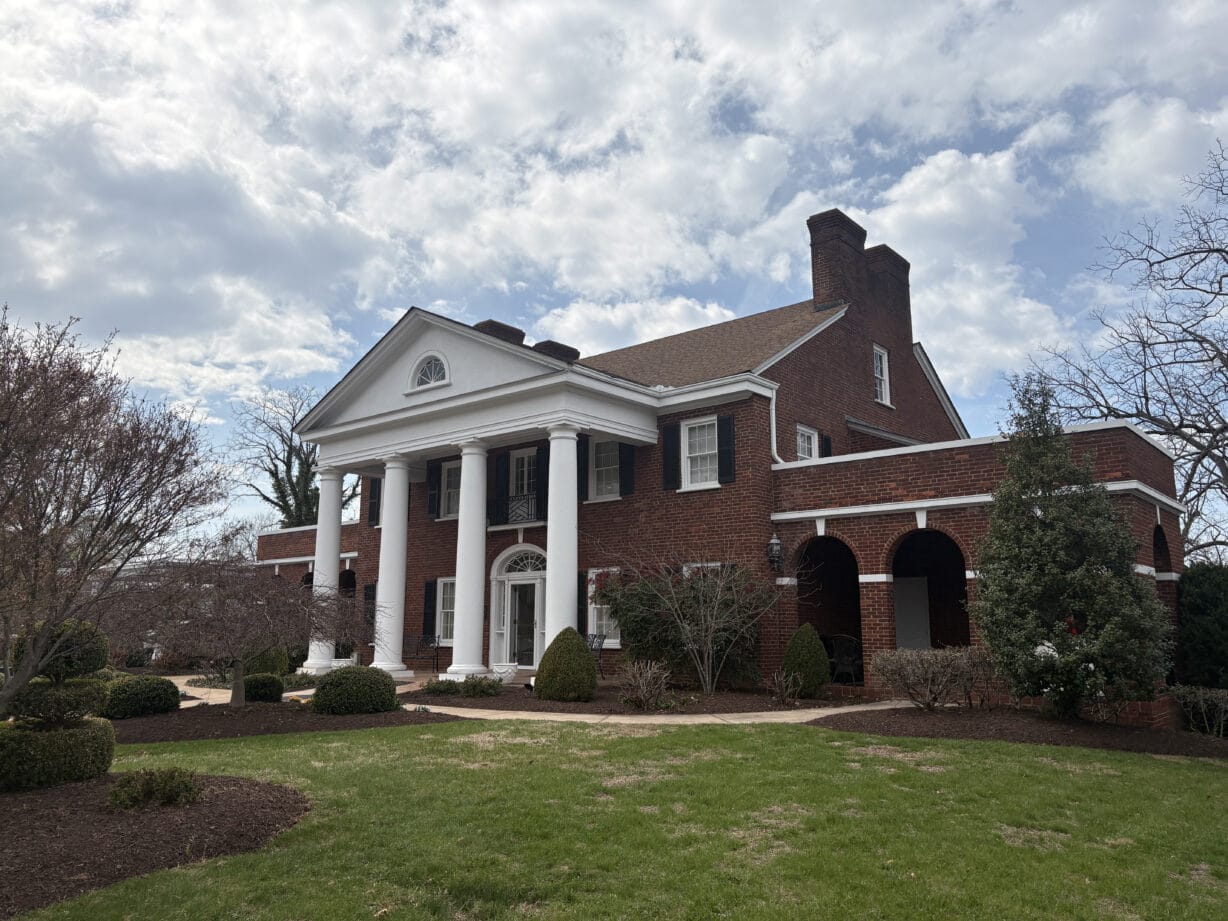
The Lindsey family constructed the present-day funeral home in stages, beginning in 1949. They chose a design that respected their neighbors along South Main Street. In materials, style, scale, and setback, the building complemented its surroundings. If you stand on its front porch today, you can appreciate its relationship with the Elks Lodge across the street. Constructed in the 1850s as an Italianate villa and later remodeled with a classical portico, the Lodge is similarly red-bricked and white-columned.
In 2005, when Landmark Preservation Associates, working with Harrisonburg Downtown Renaissance, surveyed this area in anticipation of nominating the downtown to the National Register, the Lindsey Funeral Home block was remarkably intact. The National Register survey identified “contributing resources” at 435, 457, and 495 South Main Street and 270, 276, 282, 294, and 298 South Liberty Street. In its summary of the area’s significance, Landmark described South Main Street as early Harrisonburg’s “elite residential district,” pointing to “Victorian/Queen Anne masterpieces such as the 1890 Joshua Wilton House and rarities such as the late 1880s Octagon House.” Together, these houses enhanced the historic and aesthetic character of the new district.
Unfortunately, Trenton LLC, a Lindsey-family-owned business entity, soon initiated the demolition of 435, 457, and 495 South Main Street and 294 South Liberty. Without a preservation ordinance, the city could not encourage their maintenance and adaptive reuse. They became empty lots.
What is the state of the Downtown Historic District today? Only a comprehensive resurvey could fully answer this question, but of the 167 contributing structures listed in the 2005 nomination, seven have been bulldozed within the Lindsey Funeral Home block alone. Further losses have occurred at the southern end of the district with the demolition of the houses at 706, 714, 738, and 741 South Main Street. Meanwhile the building at 11-13 Court Square has also come down. With each removal, the Downtown Historic District loses a bit of its richness and density.
Downtown Harrisonburg would benefit from new residents, new businesses, and new construction. But it is folly to believe that we can destroy and revitalize our historic downtown at the same time.
“The Link” may seem like a good way to fill in some missing gaps in our downtown streetscape, but its construction will almost certainly lead to more demolition of historic buildings. Consider the Elks Lodge, one of the oldest buildings in the Downtown Historic District. It stands across South Main Street on a 1.59-acre lot with an additional .67-acre lot to the rear. That is 2.26 acres; the Lindsey lots are 2.75 acres. Why restore or rehabilitate this building when apartments and parking decks promise fast profits?
According to the National Park Service, a historic district “derives its importance from being a unified entity, even though it is often composed of a wide variety of resources.” The Lindsey Funeral Home echoes and respects its neighbors, contributing to this “unified entity.” Radically out of scale with adjacent buildings, “The Link” would undermine the visual sense of place that pulls individual buildings and sites into a cohesive district.
A preservation-minded approach doesn’t demand that places never change; rather, it asks that we create policies that manage change wisely. The city should consider ways to develop the Lindsey Funeral Home block that ameliorate, rather than compound, the significant damage to the Downtown Historic District that has already occurred.
At some point, a historic district simply falls apart. The National Park Service tells us that a historic district can become ineligible for the National Register “if it contains so many alterations that it no longer conveys the sense of a historic environment.” This blow may be the knockout punch.
The city leaders of Harrisonburg need to treat our historic buildings like economic and cultural assets, not obstacles. These structures attract people to our downtown. The decision the City Council makes on April 28 will define our trajectory for decades. Voting “yes” without a preservation plan, without preservation policy, poses too great a risk to the public good in favor of short-term private gain.
The City Council should vote “no” on the B-1C rezoning. Responsible governance demands it.
To abandon our historic fabric is to choose a path to nowhere. To protect it is to ensure that downtown Harrisonburg remains a place worth visiting and calling home.
Philip Mills Herrington is an Associate Professor of History at James Madison University, where he teaches United States history, historic preservation, and architectural history. He earned a Master’s in Historic Preservation from the University of Georgia in 2003 and a PhD in History from the University of Virginia in 2012. He lives in downtown Harrisonburg.