



By Esther Stenson, contributor
~ Shenk, Daniel with Joyce Maxwell. Search for a Blessing: A Gay Man’s Journey from a Mennonite Missionary Childhood to the Streets of AIDS Activism. Pandora, 2026. ~
“I was born and raised in a Mennonite missionary family committed to a life of service in East Africa. And for me, because of that, there was a price to pay.”
This opening to Shenk’s memoir succinctly summarizes his view of his early years, which extended well into adulthood. From stories related to me by my cousins who grew up as missionary kids in Japan, Shenk’s early experiences of separation and disruption seem typical of missionary childhoods in the 1950’s. However, the wrenching stories he shares reveal that he paid a steeper price than did others.
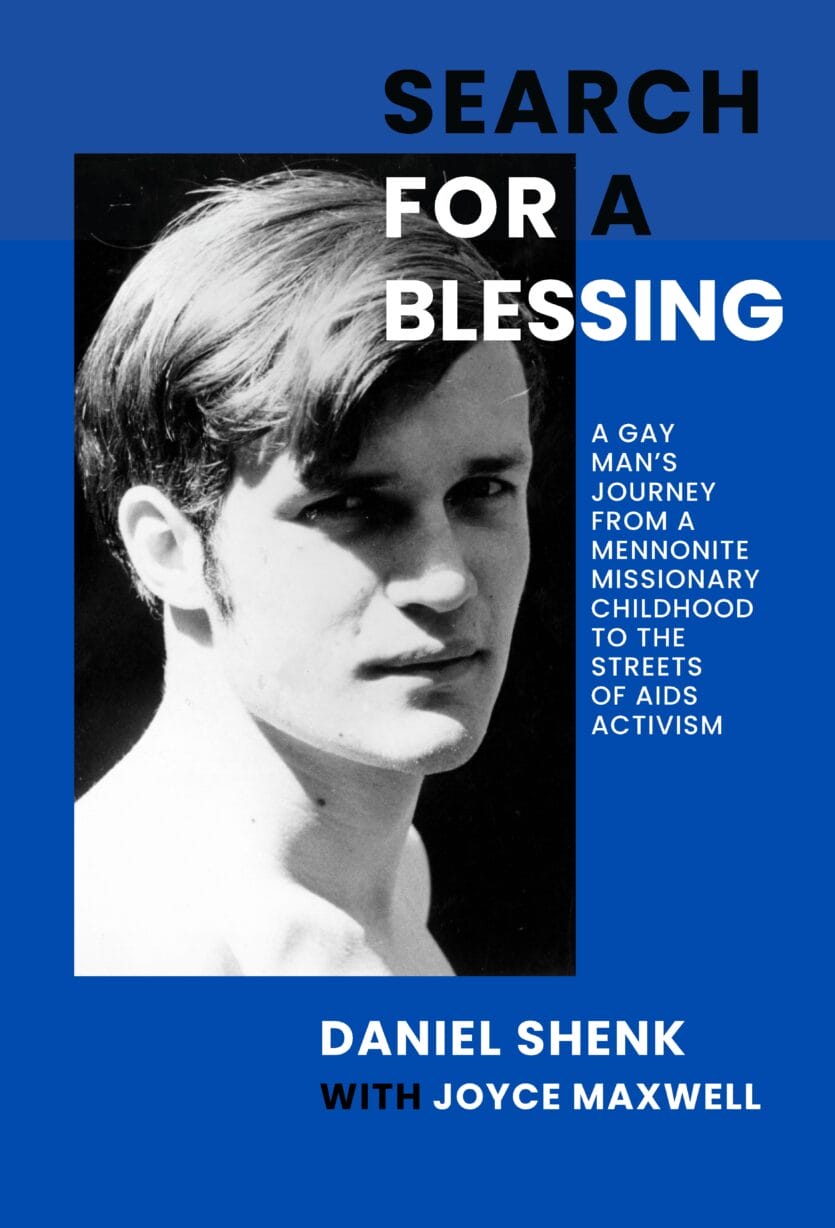
Imagine feeling loved and secure in your nuclear family and then being sent off to boarding school at age six without even knowing how to tie your shoes, for which Daniel is ridiculed. While his older siblings in boarding school could receive regular visits from their parents, Daniel cannot because of a change in the school’s location. He is not prepared for this separation and cries himself to sleep every night. Strict, unsympathetic house parents only exacerbate Daniel’s feeling of loneliness.
Furloughs back to the US every five years were meant to help missionaries stay connected to their families and churches, but they were sources of great disruption to children forming friendships and developing their identity. Just as Daniel begins to feel comfortable in one place, he is whisked off to another.
Yet, in this memoir, Shenk does not dwell only on the negatives. He objectively recognizes that people are complicated and don’t fit neatly into one box. For example, he notes that the same teacher who humiliated and spanked children also brought prized crafting tools and materials from the U. S. to enliven school projects. He also recognizes the value of his ninth grade boarding school experience in Africa where his identity as a Mennonite pacifist becomes defined by rooming with guys from different, non-Mennonite backgrounds.
In addition to the interruptions of boarding school schedules and furloughs, Dan suffers from a debilitating bout with parasites that leaves his body weak and his mind feeling inferior. At some point, Dan develops severe scoliosis, which prompts his parents to abruptly take him out of school and friendships in Africa and send him to the US for treatment. There, he enrolls in his junior year of high school where he feels like an outsider and experiences “a huge jolt.” Once more, he feels abandoned. But that step leads to another one that is life changing—an introduction to New York City where he finds the milieu exhilarating and says to himself, “Goodbye Lancaster County.”
New York also becomes the place where Shenk is radicalized politically during the Viet Nam War. He carries the mantle of activism with him throughout the rest of his life whether as a student at Eastern Mennonite University, a chaplain in Virginia and New York prisons, or an advocate for homeless HIV sufferers who need housing—generally, being an organizer and caregiver for persons living on the margins of society.
Studying existential theology in New York’s Union Seminary is where Shenk finds the vocabulary to define his life-long interior feelings of being a “wild, free-spirited girl.” Further, Shenk’s gay identity is challenged by the writings of Deitrich Bonhoeffer “to live with it in a way that was responsible and of service to the God I continued to feel passionate about” (142). While still considering his Mennonite identity, Shenk’s evolving sense of service ultimately finds a home in Judson Memorial Church which intentionally reaches out to people on the margins—people typically overlooked by mainstream churches.
Search for a Blessing may be both an uncomfortable and an inspiring read, depending on the lens of the reader. Those who have been abused sexually may experience a painful emotional response to some of the stories that include Shenk’s own devastating encounters. Those whose minds are closed to the concept of gays being acceptable to God, or who view AIDS as a just punishment for immoral behavior may reject the grace that is offered in these pages.
Readers, however, will gain insight into the workings of the prison systems in Virginia and New York. They may feel sorrow and compassion, as did Shenk, when they read about the severity of the 1980s AIDS epidemic in New York, its effects on people’s lives, and the difficulties Shenk faced in trying to bring some measure of relief for the suffering and the outcast.
Shenk’s personal struggles to find his footing as a gay man while fearing rejection by his conservative Mennonite family are perhaps what allow him to work with compassion for others in need of love and acceptance. As he says, “It’s the people who suffer greatly who can see a cultural situation or a certain norm for what it really is.”
While the book may seem long, the inclusion of other people’s stories who touched Shenk’s life further shows his ability to respect and honor the humanity of those who are suffering. As Shenk says, “I believe that storytelling is the foremost way to push back against being discounted.”
Shenk’s decision to open himself to a completely different world that helped him find his calling reminds me of my own decision to go to China in 1984, never dreaming how that initial experience would shape the trajectory of the rest of my life. Like Shenk, I am forever grateful that I accepted that challenge.
As someone who has also struggled in leaving the conservative Mennonite churches of my youth, I find affinity with Shenk’s wish to stay connected with family, which sometimes conflicted with his desire to deepen his understanding and practice of what it means to follow Jesus in various contexts. His commitment to authenticity and honesty is evident throughout the memoir. You will find no pretense, which lends the memoir its grace.
Like many of us who wonder how to live responsibly in these fraught times, Shenk asks himself every day, “What am I supposed to be doing in the homophobic world I am living in?”
Daniel Shenk and Joyce Maxwell will participate in a book launch for Search for a Blessing at 2 pm on Sunday, May 17, at Parentheses Books, 76 W. Gay St., in Harrisonburg. The program includes a reading, Q&A and refreshments.
Thanks for reading The Citizen, which won the Virginia Press Association’s 2022 News Sweepstakes award as the top online news site in Virginia. We’re independent. We’re local. We pay our contributors, and the money you give goes directly to the reporting. No overhead. No printing costs. Just facts, stories and context. We value your support.